

¿Por qué elegir BEIER Machine?
27 años de historia.
Vendido a 150 países
Vendido a 150 países
Línea de producción de extrusión de filamento para impresión 3D
En la fabricación aditiva, un diámetro de filamento uniforme y una sección transversal redondeada determinan directamente el rendimiento de la impresión 3D y la fiabilidad del flujo de la boquilla. Una línea de producción de extrusión de filamento para impresión 3D debe eliminar las fluctuaciones térmicas en la zona de fusión, manteniendo al mismo tiempo una tensión lineal estable durante el enfriamiento y el bobinado.
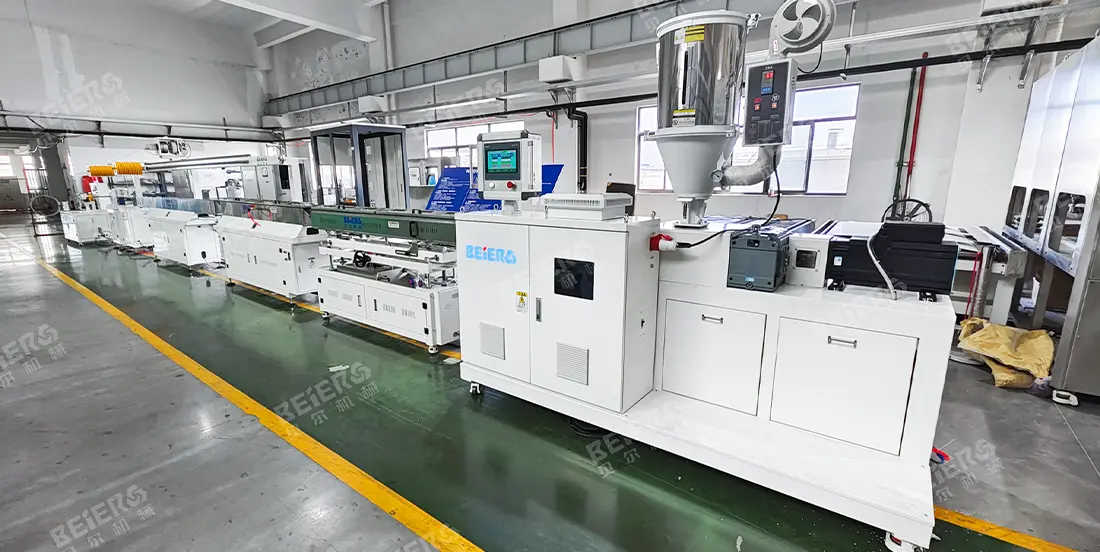
Diseñada específicamente para el procesamiento industrial de polímeros, la línea de producción de filamentos para impresión 3D de BEIER prioriza la homogeneidad de la fusión y las dimensiones físicas precisas por encima de la simple velocidad de producción. Ya sea para fabricar bobinas estándar de PLA de 1,75 mm o plásticos de ingeniería de alta temperatura como el PEEK, nuestro sistema de extrusión de alta resistencia proporciona el control de circuito cerrado necesario para un funcionamiento continuo y fiable.
Componentes de la línea de producción de filamentos para impresión 3D:
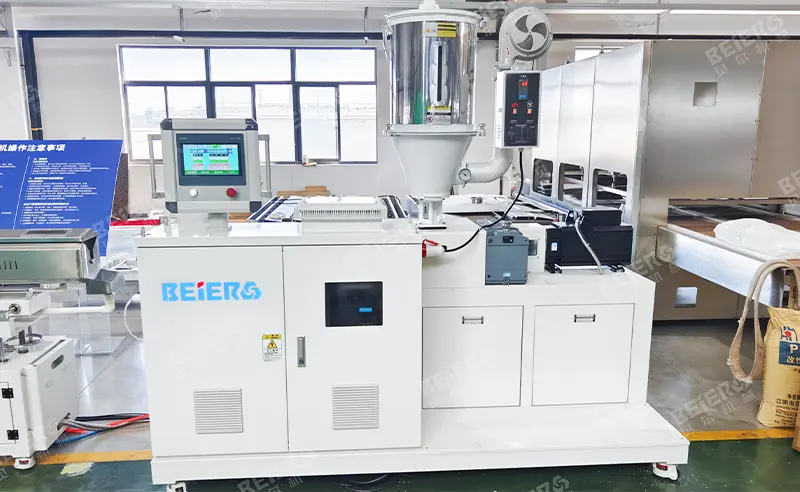
Extrusora de precisión de un solo husillo
Incorpora un husillo de polímero BEIER específico con una relación L/D de 28:1 o 30:1, optimizado para la fusión a baja cizalladura. Los controladores de temperatura PID multizona mantienen la temperatura del cilindro estable dentro de ±1 °C.
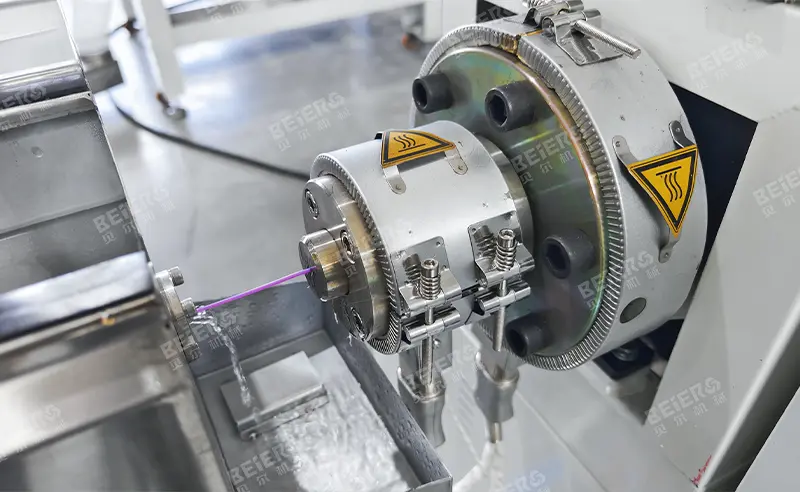
Cabezal de troquelado de alta precisión
La geometría personalizada del canal de flujo evita la degradación y el estancamiento de la resina, lo que produce un flujo de material fundido uniforme antes de su entrada en el sistema de enfriamiento.
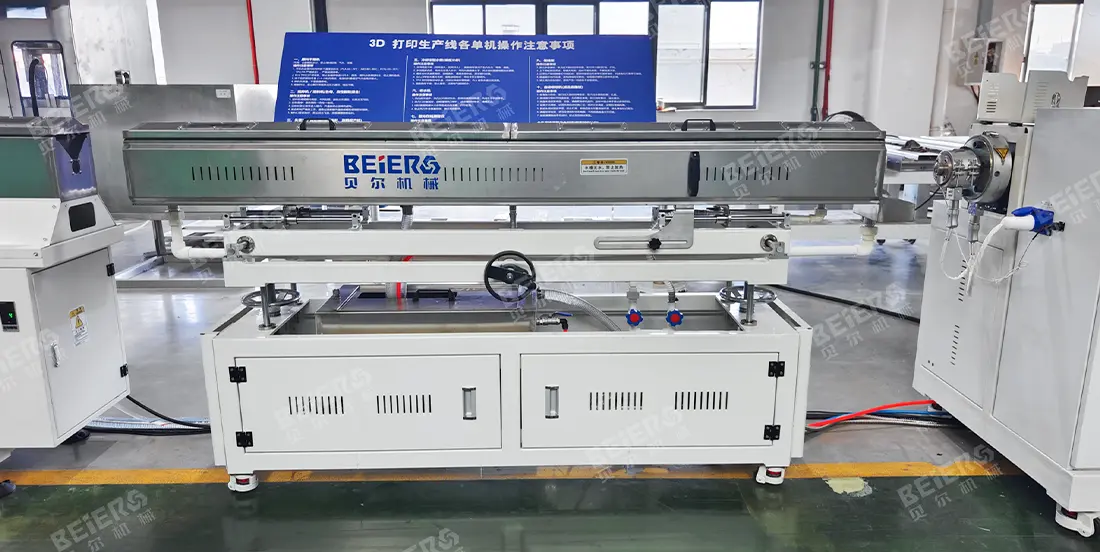
Tanque de refrigeración con control de temperatura multietapa
Incorpora opciones de regulación precisa de la temperatura del agua y de dimensionamiento por vacío para ajustar la forma del filamento sin provocar choques térmicos ni tensiones internas.
Medición de diámetro mediante láser de doble eje
La detección continua en línea mide las dimensiones X e Y. La retroalimentación en tiempo real se conecta directamente con la unidad de transporte para la corrección dinámica de la tolerancia.
Unidad de arrastre accionada por servomotor
Los rodillos de contacto de goma que no dejan marcas, accionados por servomotores de precisión, mantienen una velocidad de tracción constante sin deformar el filamento semirrígido.
Enrollador automático de doble estación con tensión
Los precisos mecanismos de desplazamiento garantizan un bobinado uniforme de la bobina sin superposiciones, manteniendo una tensión constante de principio a fin.
Vídeo de la línea de extrusión de filamento para impresión 3D:
Compatibilidad de materiales y versatilidad de procesamiento:
Una línea de extrusión de filamento para impresión 3D diseñada por BEIER procesa una amplia variedad de materiales termoplásticos con diferentes índices de fluidez y propiedades térmicas:
- Polímeros de uso común (PLA, ABS, PETG, HIPS): Procesados con perfiles de enfriamiento optimizados para evitar deformaciones y encogimientos.
- Elastómeros flexibles (TPU, TPE): Se manipulan con guías de baja fricción y un control preciso de la tensión para evitar el estiramiento axial durante la extracción.
- Resinas de ingeniería y de alta temperatura (nylon/PA, PC, PEEK): Configuradas con zonas de calentamiento de alta temperatura y cilindros de aleación especializados resistentes al desgaste.
Sistema de control de calidad de circuito cerrado:
La variación del diámetro es la principal causa de deslizamiento de los engranajes del extrusor y de atascos en el cabezal de impresión de las impresoras 3D. La línea de extrusión de filamento para impresión 3D de BEIER utiliza un sistema de retroalimentación PLC integrado de circuito cerrado. Si el medidor láser detecta una desviación dimensional que excede los parámetros establecidos, el controlador ajusta automáticamente la velocidad del motor de arrastre en cuestión de milisegundos, manteniendo las dimensiones objetivo dentro de ±0,02 mm.
Preguntas frecuentes:
P1: ¿Qué tolerancias de diámetro puede mantener de forma consistente la línea de producción de BEIER?
A: En condiciones normales de funcionamiento y utilizando materias primas debidamente secas, la línea mantiene una estricta tolerancia de diámetro de ±0,02 mm tanto para filamentos de 1,75 mm como de 2,85 mm.
P2: ¿Qué resinas de materia prima son compatibles con esta línea de extrusión?
A: El sistema procesa termoplásticos estándar como PLA, ABS, PETG y HIPS, así como TPU flexible. Las configuraciones de alta temperatura permiten procesar PA (Nylon), PC y PEEK.
P3: ¿Cómo evita el equipo de BEIER la ovalidad o la deformación del filamento?
A: La ovalidad se controla mediante un diseño preciso del canal de la matriz, una temperatura de fusión controlada y un enfriamiento en baño de agua de varias etapas que disipa el calor de manera uniforme antes del contacto de arrastre.
P4: ¿El sistema de medición de diámetro por láser está automatizado?
R: Sí. El medidor de diámetro láser de doble eje proporciona información en tiempo real al PLC central, ajustando automáticamente la velocidad de arrastre para mantener estable el grosor del filamento.

 Inglés
 Español
 persa
persa ruso
ruso WhatsApp: +86-13814880186
 Spanish
  Spanish
 English
  Persian
  Russian